

SummaryOpen the quick read
- Prince Nofemela grew up in Nyanga, Cape Town, where witnessing widespread crime inspired his dream to become a state prosecutor.
- He lost his sight at age 20 due to a severe TB infection while pursuing science studies at the University of Cape Town.
- Refusing to quit, he transitioned to education, taught at special schools, and later completed a law degree through Unisa using advancing technology.
- After joining the National Prosecuting Authority's aspirant programme in 2021, he was appointed as a permanent district court prosecutor in Mthatha in 2022.
- Relying on speech software, scanners, and a personal assistant to review dockets, Nofemela now aims to prosecute in the regional and high courts.
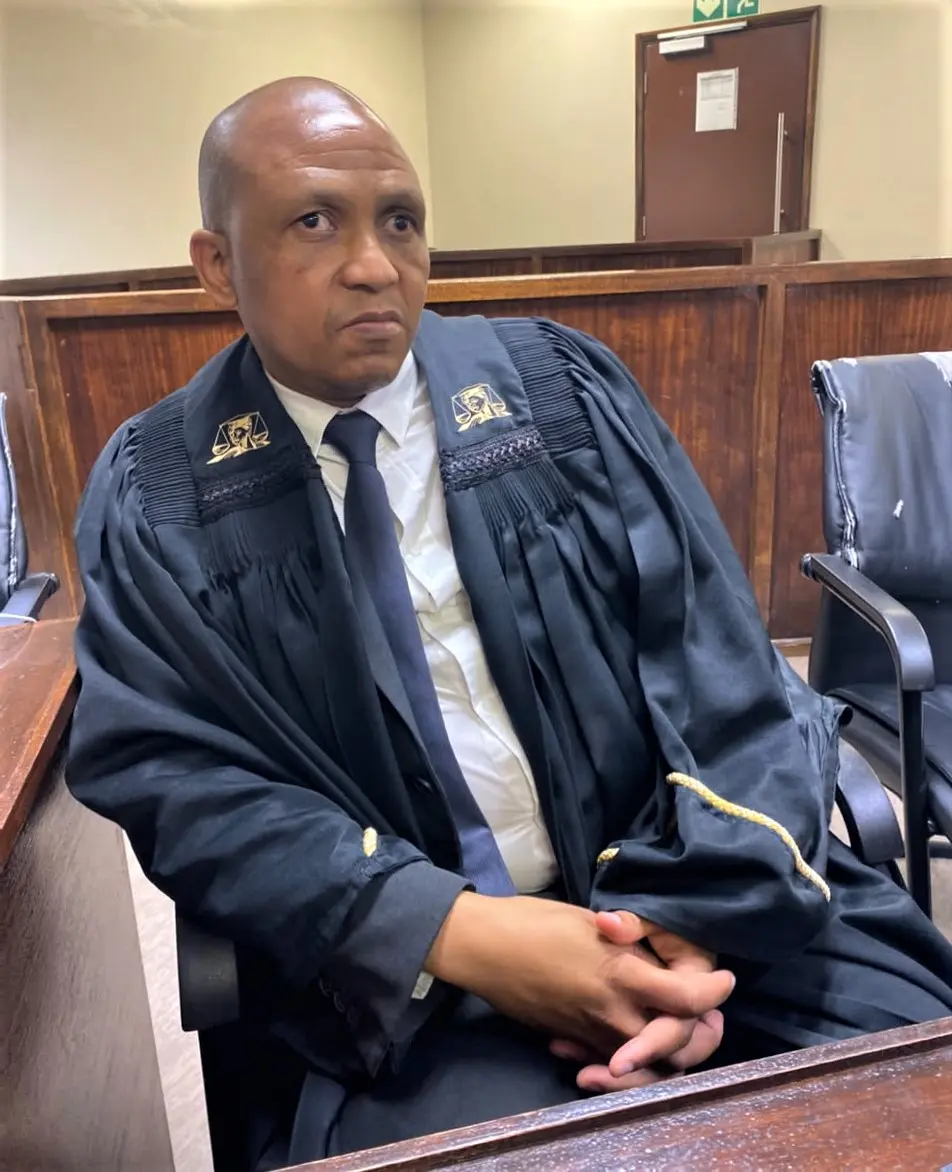
Growing up in Nyanga township, a community gripped by crime in Cape Town, Prince Nofemela watched too many victims suffer in silence, and have their stories end before anyone heard them.
As a young boy, he made a promise that one day he would be the voice that spoke for them and that sparked the dream of being a prosecutor.
Then life tested that promise in the cruellest way as a TB infection left him completely blind in 1997 at the tender age of 20 while pursuing a bachelor of science at UCT with a goal to teach mathematics, physical science and biology.
For most, that would have been the end of the dream, but for Nofemela it was the beginning of a different kind of seeing.
Two years later when he returned to university, Nofemela, by then a father of two girls, decided to change course to the humanities faculty, completing a degree in education in 2003 and teaching at special schools in the Western Cape in 2004.
In 2009, he enrolled for a law degree at Unisa while working as a teacher. He obtained this in 2015.
After qualifying as a lawyer, Nofemela, whose family is originally from Upper Ndwana in Cala, applied for the National Prosecuting Authority aspirant prosecutor programme, but it was discontinued in 2015.
He came a step closer to his dream in 2020 when the programme was reintroduced and he was accepted, becoming an aspiring prosecutor in 2021 until he was permanently employed in 2022 as a district court prosecutor.
"This prosecutorial dream started where I grew up in a crime-ridden area in Nyanga observing people commit various types of crime just because they could, and I felt that sometimes people are just helpless at the way crime was spiking," he said.
"After I lost my sight I tried to enrol for a law degree but I faced many struggles because technology at the time was still primitive, and a law degree was going to be a big mountain to climb, so I took the route of education.
"While I was teaching I felt that I was ready to go back to my dream."
As technology advanced, he said he became confident enough to pursue his dream and completed the law degree through online learning.
The exciting moment was when he received a call that he had been accepted for the prosecutor programme and would be starting his dream job in January 2021.
As he had never been to Mthatha before, Nofemela's excitement over his new job dampened somewhat as he had to adapt to a new environment as a blind person, facing orientation and mobility challenges, such as using transport.
However, he quickly made friends who assisted him to get acquainted with his surroundings, and when this was achieved, the excitement returned as he observed what he learnt in theory being practised in court.
Nofemela, who also worked as a teller at FNB before becoming a teacher, credited his aspirant prosecutor programme mentor who worked closely with him in his early days and assisted him with docket contents before he got his own personal assistant.
He uses a speech-programmed computer, cellphone and scanner to help him in his work, as well as a walking stick to navigate his way.
Challenges arise when his scanner cannot pick up handwritten notes in the dockets. However, this is where his personal assistant steps in.
While talking to the Dispatch, Nofemela was also assisting colleagues who came knocking on his door to ask for his input on matters of law.
Robed in his black gown and armed with the desire to ensure justice is served, Nofemela said he wore the shoes of the victims out of empathy and became their voice.
That chucks out nervousness, and the sense of justice takes over, he said.
"That is what drives me. The desire to achieve justice for the people who otherwise would not have anybody to speak for them, and also remembering that this is what I grew up having a desire for," he said.
"I'm here to make people account for the wrong that they do."
As he wants to remain a prosecutor, the next level for Nofemela is prosecuting cases in regional court, and later proceeding to work in the high court.
He's the only visually impaired prosecutor in Mthatha but is not the only one in the NPA.
"I'm not the first one, and there are many to come," he said.
"We face similar challenges, but all blind people are different. I like to rely more on technology because I want to do my own work. The main challenge for me is handwriting."
When he's not in court or preparing for cases, Nofemela follows sport, especially soccer, cricket, tennis and rugby.
A committed Christian, he also follows current affairs, catches up on movies, following the soundtrack with his partner at home, exercises in his home gym, takes walks and spends time with his family.
He also reads up on the latest court decisions to equip himself even better in his job.
For a long time he was also a DJ, but this work took its toll on him.
In the words of former statesman Nelson Mandela – "It always seems impossible until it's done" – Nofemela believes in not giving up.
"There are some things that are difficult to the point of being impossible," he said.
"I love aviation and I believe I would have been able to become a pilot even with my disability, because modern-day airliners have well-advanced autopilots.
"A person must have their dream, conduct their research, align themselves with the right people and people in similar situations, and they will see that it's possible."
When this reporter saw Nofemela for the first time, he was in court opposing the release on bail of two men accused of murder.
"I live a fulfilling life even with the disability, up to a point that my disability is not even something I think about anymore and the way I carry myself, because it's not my identity, just something I live with," he said.
"I do appreciate a lot of people have not seen this before and I know the importance of speaking about this and reaching as many people as possible. I have an open-door policy."
Daily Dispatch