

SummaryOpen the quick read
- Acclaimed filmmaker Etienne Fourie has published his debut children's book, InterVille, a project he conceived 17 years ago.
- The story centres on 12-year-old Patrick, who discovers a gateway to magical worlds while attending a summer camp for eccentric children.
- Fourie drew substantial inspiration from his childhood growing up along the Eastern Cape coast and his lifelong friendships.
- A key message of the book is embracing personal quirks and self-consciousness, such as allergies, as unique strengths.
- InterVille is planned as a five-part book series, with Fourie also penning a new young adult trilogy and developing international screen projects.
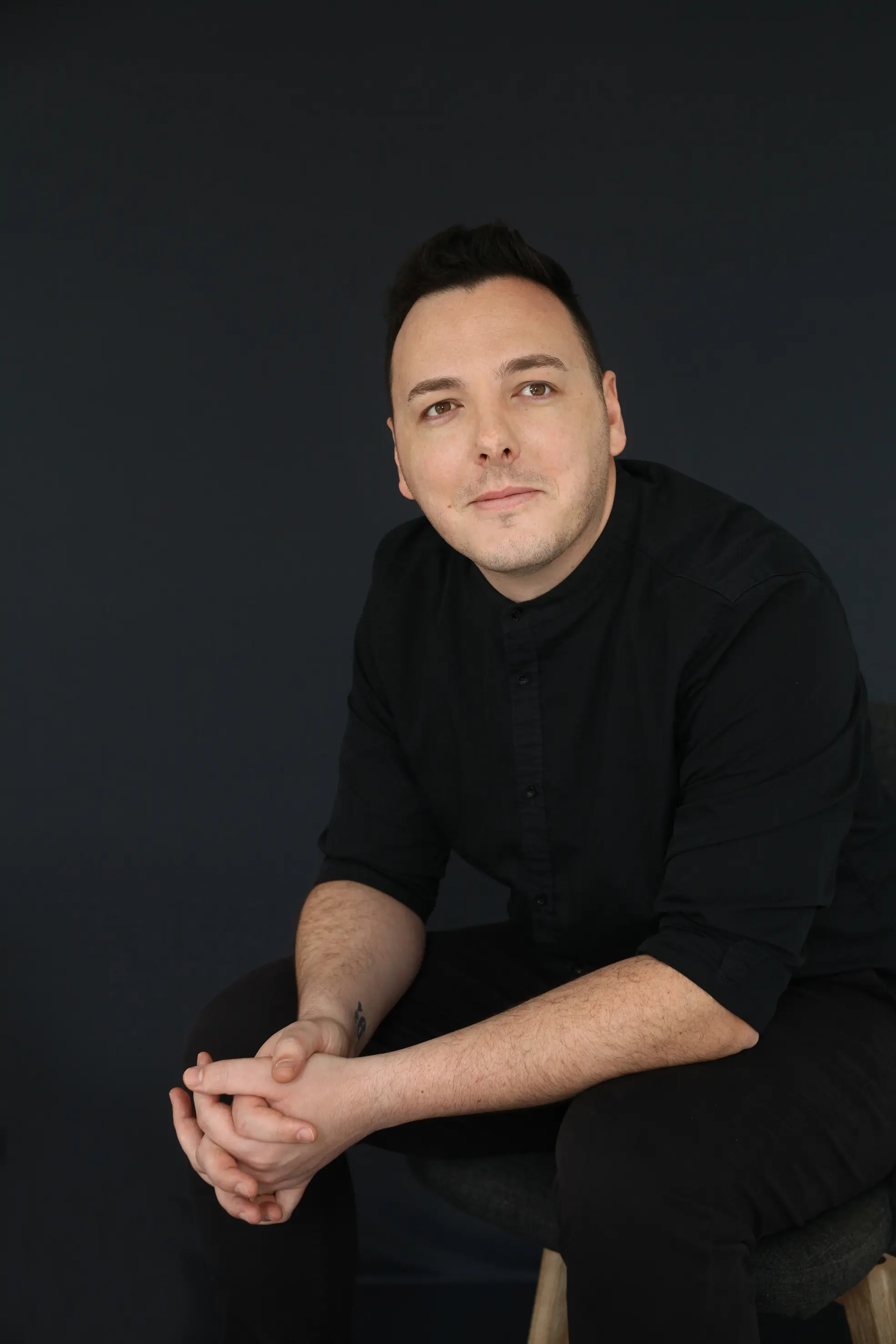
From his Eastern Cape childhood where he relished life on the coast, to the world of mysterious creatures and extraordinary adventures in his new children’s book InterVille, award-winning filmmaker Etienne Fourie may be giving a certain famous boy wizard a run for his money.
Fourie, 38, grew up in St Francis, Jeffreys Bay and Humansdorp before completing an honours degree in screenwriting and directing at AFDA in Cape Town where he now lives with his partner, Suidooster writer and filmmaker Retief Scholtz.
Fourie, who is best known as the writer of Showmax series Trompoppie and the movie Windpomp, says writing InterVille has been on the cards for 17 years and transports young readers to impossible worlds filled with terrifying creatures.
The book, about a group of 12-year-olds who go to a holiday camp, includes strong themes of kindness and inclusion. It is also about the irritation of allergies.
“I wanted to take something a child might find embarrassing or regard as a weakness and turn it into something extraordinary,” he says. “Patrick’s allergy causes endless chaos, but it also has the potential to become a kind of superpower. Many of the qualities we feel most self-conscious about when we’re young can eventually become assets. Not necessarily because they change, but because we learn to see and use them differently.
“InterVille, for me, is really about the power of kindness and celebrating the things that make us all unique. Learning that at an early age saved me. It made my life beautiful. And if this book can sprinkle even a tiny bit of that into the world, I’d be the most grateful writer alive.”
Daily Dispatch asked him:
You spent some of your childhood in the Eastern Cape, including St Francis and Jeffreys Bay. What are your strongest memories growing up there and did the area play any part or inspire 'InterVille' in any way?
Growing up in the Eastern Cape had a massive impact on InterVille and, frankly, everything I write. But this is particularly true for InterVille, as the plot follows a group of 12-year-olds. I was lucky enough to make really wonderful friends, which was especially tough as “the new kid” in the third grade, but none more magnificent than my friend Muller. He was — and remains to be — unlike any other person I’ve ever met.
He taught me how cool books are, how humour is best when it’s kind and clever, and the sheer power of leaning into what makes us all unique — which was particularly challenging at that age. I carry that with me to this day. And there are just so many stories from that time — especially around the ages of 12 and 13 — that make me laugh harder than anything else. I really tried to capture some of that joy in InterVille.
How did growing up on the coast shape you?
I honestly can’t imagine not living by the ocean. I vividly remember the night we arrived in St Francis Bay for the first time, with all our belongings packed up and on their way from Lephalale.
I’d fallen asleep in the back of the car, and my dad carried me into the new house. But the smell of the ocean and the fynbos hit me — and woke me right up. It’s been a part of me ever since. Another consequence of growing up on the coast is how tourist season shaped my professional rhythms and work ethic. My parents worked harder over the December holidays than at any other time of year.
You are an award-winning writer and director of very “grown-up” material like the movie 'Windpomp' and the Showmax television series 'Trompoppie'. What inspired you to write a children’s book?
A children’s book is actually what I’ve wanted to write most of all. Something I suspected as a child, and which adulthood has only confirmed, is that we’re all really just children at heart.
Having to pay taxes doesn’t change that, even if we sometimes forget it. It’s also why I’ve been absolutely adamant throughout my career about never being boxed into a particular genre or age group. I can write a murder mystery and a children’s story from the same chair, because as a reader, I love both — and just about everything in between.
Whether this will prove to be a particularly clever career strategy remains to be seen, but I’ve always believed that the moment I stop writing what I genuinely care about is the moment I stop writing, full stop.

What inspired the 'InterVille' story? How much of the Eastern Cape boy you once were is in this story?
I’ve come to the rather disappointing conclusion that adulthood is a scam. Far too many responsibilities, far too little fun, and nobody warned me about the admin. So I suppose InterVille was born out of a desperate desire to escape it all.
Growing up I had a deep love for stories that could transport me to extraordinary places. I wanted to recapture that feeling of being a child, when the world seemed full of endless possibilities and something magical might be waiting just around the corner. And if the book can give young readers even a fraction of the wonder I felt when discovering my favourite stories, I’ll consider it a tremendous success.
Did you draw on your own childhood experiences when developing any of the characters in 'InterVille'?
Oh, definitely! So much of the dynamic between the core group of characters (known at camp as the “Groaks”) was inspired by my own childhood friendships.
Those friendships taught me so many wonderful things, including the belief that the “coolest” thing you can do is often simply to be yourself — to embrace whatever it is that makes you different, rather than trying to fit in. I’m incredibly grateful that this philosophy has stayed with me into adulthood.
What can young readers expect of the world of 'InterVille'?
As if his new and highly inconvenient electricity allergy which makes it impossible for him to come near technology isn’t enough, Patrick receives the worst birthday present – real-life experience. A summer camp for “stubbornly unique” individuals.
Camp Crooked Creek Canyon — a mosquito-infested wilderness nightmare he’s fairly certain he won’t survive — is set on one of countless islands in Lake Korno (an ancient meteor crater). Camp Crooked Creek Canyon is officially branded as a camp for “socially awkward, stubbornly unique individuals”, which rightly makes Patrick nervous.
Furthermore, the camp has a rather unusual system: depending on how well each camper performs in a series of increasingly ridiculous challenges, they can end up staying anywhere from a beautiful old manor house with 24/7 chocolate fountains and a cinema room, to a hovel perched in a swamp — which, unfortunately, is where Patrick and his new crew of oddball friends find themselves.
But camp is far stranger than Patrick imagined. Soon, he discovers a glowing creature stalking the forest at night, a wanted giant armed with a butterfly net large enough to catch a pterodactyl, and the mysterious Verdigris Island, haunted by the legend of a monster and a boy who went missing there a hundred years ago. Verdigris Island is also home to a magical Gate leading to InterVille, where impossible worlds and terrifying creatures await. And it becomes Patrick’s responsibility — along with his new friends — to defend our world against what lies beyond.
What do you hope children will take away from reading it?
More than anything, I wanted to create a story world where kindness and humour are rewarded. That was always top of the list for me, and I think it’s more important now than ever. I also wanted to show how the very things that make us feel self-conscious, especially when we’re young - like Patrick’s rather dramatic allergies, for example - can often turn out to be blessings in disguise.
As a child, I was always the kid drawing on every available surface, painting, writing stories, sculpting monsters out of clay or carving them from wood. I often felt like the “weird” one, but luckily, I realised in time that these were not things I needed to feel ashamed of. Quite the opposite, in fact. They would eventually become my greatest salvation. I feel incredibly fortunate to have made a career out of the things I love most, and that’s something I never take for granted.
Children have so many distractions these days especially with their access to devices. Why is it important that they read books like yours?
InterVille does not set out to demonise screen culture, but simply illustrate what other adventures can also be had outside the confines of a screen. The protagonist, Patrick, who starts off as an avid gamer with a terrible fear of the world he finds himself in, learns to “look up” and appreciate the wonder of his IRL adventures.
There’s a wonderful — and in my opinion sacred — relationship between book and reader. Allowing my own mind to conjure up not only images, but deciding on the pace,the inflections of dialogue, etc. is cooler than any movie I’ve ever seen. And if I didn’t have that, I would be poorer for it. Young people who perhaps haven’t quite embraced the joys of reading should have serious FOMO, and I can only hope that InterVille can convince them to read more.
Please tell us about your own allergies!
Even just thinking about a cat makes my nose twitch. Which is a shame, because I absolutely love cats. And my loudest sneezes always seem to sneak up on me at the most inconvenient moments — like right in the middle of a particularly good take on a film set.
Were you an imaginative child? Did anyone special play a role in encouraging you to tell stories?
I think it’s fair to say (and I suspect my mother and teachers would agree) that my imagination as a child was verging on being overactive. It’s the thing I valued most of all. Whenever I could get lost in a book, movie, TV show, or even music, I was at my very happiest. Escapism on steroids. The world around me never really made much sense to me — and it still doesn’t, frankly. But in story worlds, I felt safe. And whenever I sketched or painted or sculpted, the noise of the world disappeared.
What first drew you to filmmaking?
I started out as a fine artist and I paid the bills for several years working as a storyboard artist for commercials.
Once I realised that the canvas was no longer big enough to put down what I saw in my mind, I started writing it down. Soon, I discovered the sheer joy of creating a story, the characters, and a world for them to inhabit. Film, in the end, felt like the best combination of those two passions: visual art and writing/storytelling. Some days I wish I’d taken a more traditional route - freelancing is no joke - but then I try to imagine myself doing anything else, and I recoil. I love what I do, even though it’s difficult and challenging. It really does keep me going, and I never take it for granted.
How does this project compare with your normal work – are there any common threads running through filmmaking and publishing this book?
The thing about making a film or TV series is that by the time I’ve written and directed it, about a hundred other people have had to make impossible magic happen to get us to the final product. It’s incredibly collaborative. And that can, honestly, go one of two ways.
And with a book, even though it’s still really quite collaborative, especially considering the editors — saintly geniuses who help to whip books into shape and make authors look good — the end result is ultimately something I have to take responsibility for, whether good or bad. And that’s both liberating and also terrifying.
And in comparison to my previous work, InterVille in many ways feels like the most natural piece of writing for me to produce. It’s what I like to read most, even as an adult. I always head for the children’s and Young Adult sections first of any bookstore I’m in. And I’ve been sitting with the story for a very long time — 17 years, in fact. I had the initial idea in my second year at film school, and many of the scenes I wrote then, I’m happy to say, made it into the final version of the book.
Please tell us about the follow-ups to this book?
InterVille is a planned series of five books. I’ve already worked out much of the upcoming stories and I have a pretty good idea where the characters are going and how they will develop. I can’t say too much about the upcoming books (I don’t want to spoil anything), but I can say that each book will not necessarily represent a year in the characters’ lives. The first book hints at some of the other worlds that Patrick and the Groaks are yet to discover, and I cannot wait to travel there with them and ultimately invite readers along for the ride.
What other projects do you have coming up?
Over the past couple of years, after the wild ride that my previous TV project, Trompoppie, was for me, I’ve been fortunate enough to work on several international projects, including a BBC project that I really can’t say much about.
There are several TV series and films in the works, some of which I’m writing and directing, others I’m just writing or producing. It’s a mixed bag, but it keeps me on my toes and keeps boredom at bay. I’m also nearing the end of my next novel — a Young Adult book that is the first of a trilogy — also for Penguin Random House.