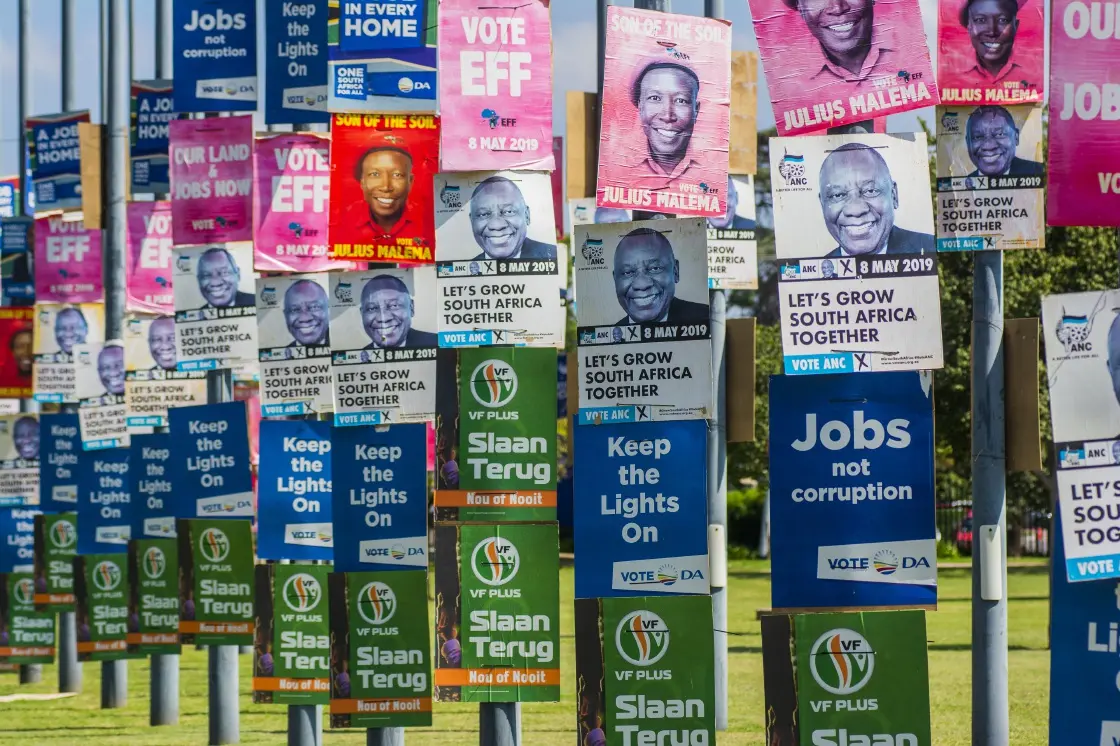
Expressions of support, however sincere or numerous, carry no formal weight.
A party may command large gatherings, enjoy high name recognition and receive favourable commentary in communities, yet still underperform if a significant portion of its potential supporters becomes discouraged and simply elects not to participate.
Conversely, a formation with a smaller but more consistent base of actual voters can secure a larger share of the counted ballots. Expressed preference is not equivalent to a recorded vote.
The 2021 local government elections furnish a clear empirical illustration.
According to the Electoral Commission of SA, turnout declined from 57.94% in 2016 to abot 45.79% in 2021 — the lowest recorded level in the local elections held between 2000 and 2021.
Roughly 12.3 million of the approximately 26.1 million registered voters cast ballots.
That contraction altered the arithmetic of many contests and expanded the number of hung councils.
It demonstrated, in concrete terms, that the actual composition of the participating electorate differs materially from the composition of the eligible or registered electorate.
The practical consequences of that difference operate through several interlocking channels.
Parties whose supporters convert intention into ballots will register stronger results than parties whose supporters remain at home; the absolute size of a support base is secondary to the rate at which that base participates.
In closely contested wards, where candidates may be separated by only a few hundred or even a few dozen votes, modest changes in local turnout can reverse the result.
Unfortunately, in a democracy such as ours, the councillor is determined by the votes present on the day, not by a theoretical preference of the broader community.
Demographic composition matters in the same way; younger eligible voters constitute a substantial share of the voting-age population.
Their presence or absence shifts the character of the participating electorate and, by extension, the policy priorities that municipal councils are likely to reflect. Geographic variation compounds that effect.
Turnout is rarely uniform across wards, towns, and metropolitan areas. An increase in participation in one cluster of wards can alter the seat distribution within a municipality even if national aggregates appear stable.
Local elections are, by design, a series of concurrent municipal contests rather than a single national plebiscite.
These variations then feed directly into the formation of local government councils.
Where no party secures an outright majority, the precise allocation of seats determines which combinations of parties can negotiate governing arrangements.
Marginal shifts produced by differential turnout can therefore reshape the architecture of local authority for an entire five-year term.
National popularity, measured by opinion polls or aggregate vote share, remains an incomplete guide.
A party may improve its national percentage yet fail to win wards or secure majorities in specific municipalities.
A party with concentrated support in particular communities may win critical wards without dominating nationally. Accurate assessment requires examination at the municipal and ward levels.
Of course, higher turnout does not automatically advantage any single party.
Its effects depend on which registered voters participate, the choices they make, and the specific electoral thresholds operative in their municipalities.
The decisive question for 2026 is therefore not how many citizens express support for a particular formation, but how many eligible registered voters cast valid ballots and how those ballots translate into council seats.
Beyond the immediate arithmetic, turnout bears on the legitimacy and effectiveness of local government.
Municipal councils exercise authority over the services that most directly shape daily life such as water, sanitation, local roads and spatial planning.
When large numbers of registered voters abstain, the mandate of the resulting council rests on a narrower foundation.
Sustained participation strengthens the link between citizen preferences and institutional decisions, reinforcing the accountability mechanisms that local government is constitutionally intended to provide.
To this end, leadership quality, service-delivery records, public trust, campaign organisation and local conditions all shape voter choice.
Yet none of these factors registers in the official result unless citizens convert their assessments of these matrices into ballots.
The 2026 local government elections will be shaped significantly by participation because, in a representative democracy, outcomes are produced by those who vote, not by those who merely intend to.
Citizens therefore hold a practical instrument of influence. Casting a ballot on November 4 2026 constitutes the mechanism through which preferences enter the formal calculus of local government.
In numbers, that participation can determine which councils are formed, which priorities are advanced and how closely the composition of local authority reflects the communities it serves.
Your turnout, not intention, will decide 2026. Make it to the ballot to vote!
Dr Bhekisisa Jacob Mthembu is the municipal manager of Amathole District Municipality, patron of the Bhekisisa Foundation, an author, and a philanthropist.