

The debate over oil and gas has never been limited to the politics of energy sovereignty.
However, it is also about power, sovereignty, national security and the distribution of wealth.
Likewise, the current geopolitical environment makes this difficult to ignore.
From the strategic importance of Venezuela’s oil reserves to the disruption of the Strait of Hormuz, control over energy resources continues to shape international relations and domestic economic choices.
For instance, the strait alone carried about 20 million barrels of oil and petroleum products a day in 2025, roughly a quarter of global seaborne oil trade.
Whereas its disruption in 2026 has demonstrated how quickly a geopolitical crisis can become an energy and economic crisis elsewhere.
For SA, these developments give renewed significance to the search for domestic oil and gas resources.
However, they also raise a more difficult question: can the country pursue energy sovereignty without reproducing the political and economic inequalities associated with resource extraction elsewhere in Africa?
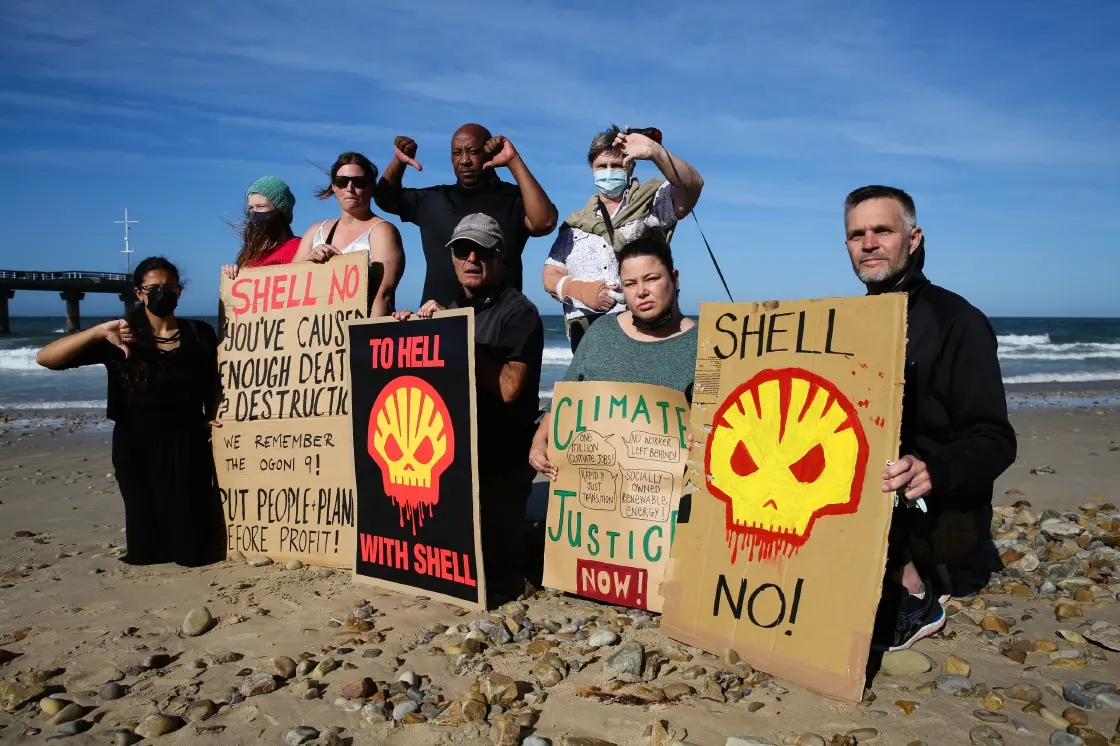
This question is particularly important in the Eastern Cape, where offshore exploration is unfolding against a background of poverty, unemployment and historical marginalisation.
The province is increasingly positioned as a potential frontier for oil and gas exploration.
At the same time, communities, environmental organisations, multinational corporations, government and traditional authorities continue to contest the environmental, economic and social consequences of exploration.
SA’s relationship with oil is hardly new. Energy security became a strategic concern as the country faced increasing international isolation during the apartheid era.
As a result, the establishment of Soekor in 1965 reflected the state’s determination to develop domestic petroleum capabilities.
Moreover, by the 1970s, international oil sanctions and the Arab oil embargo had reinforced the strategic importance of energy security.
Oil, therefore, became intertwined with the country’s political economy and its struggle to maintain economic autonomy under international pressure.
The contemporary context is different, but the underlying question remains familiar: how much control does SA have over the energy resources on which its economy depends?
The answer is uncomfortable, as SA remains heavily dependent on coal, while its natural-gas market is small but strategically important.
The country’s gas master plan estimates that natural gas accounts for only about 2.6% of the energy mix, yet nearly 90% of existing gas demand is supplied by Sasol Gas.
This concentration exposes the industry to significant supply risks.
The vulnerability is compounded by dependence on Mozambique.
The interruption or decline of Mozambican gas supplies threatens industries ranging from chemicals and petrochemicals to steel, glass, ceramics and food processing.
At the same time, Mozambique itself demonstrates both the promise and danger of resource development.
Its $20bn (R330bn) Mozambique LNG project restarted in January 2026 after a five-year suspension caused by militant violence in Cabo Delgado, with first production targeted for 2029.
These examples expose the central contradiction facing SA.
Domestic oil and gas development can potentially improve energy security, support industrialisation, generate fiscal revenues and create employment.
But resource extraction does not automatically produce development. This is where the resource-curse debate becomes relevant.
Nigeria and the Democratic Republic of Congo demonstrate how resource wealth can coexist with poverty, conflict and weak institutions.
Botswana, by contrast, demonstrates that natural resources can contribute to development when supported by capable institutions, sound policies and investment in infrastructure and human development.
The lesson is therefore not that SA should either embrace or reject oil and gas.
It is how the sector will be governed, who will benefit, and whose interests will determine its development trajectory.
This question becomes particularly important in the Eastern Cape, where traditional authorities hold a prominent position in many rural communities.
Their involvement in resource exploration can facilitate community engagement, but it can also raise difficult questions about representation, consent and accountability.
The reported support of traditional leaders for seismic exploration illustrates the significance of these institutions in securing local acceptance.
Yet consent cannot be reduced to a procedural box to be ticked to enable investment.
Communities living alongside extraction sites must have meaningful participation in decisions affecting their land, livelihoods and environment.
Government, traditional authorities and corporations must therefore be held to a standard of transparency that extends beyond consultation.
SA should also be cautious about presenting oil and gas as a straightforward development solution.
The country does need a reliable and affordable energy supply. More importantly, it needs to develop industrial competitiveness.
Likewise, employment and investment are important aspects for the country and the Eastern Cape’s development.
Yet, these objectives cannot be separated from questions of distribution, environmental protection and institutional accountability.
The real danger is not simply that SA may discover too much oil or gas. It is that the country could discover resources without developing the governance capacity required to manage them.
Energy sovereignty should therefore mean more than owning or accessing domestic resources.
It should reflect the building of institutional capacity to determine how those resources are developed, revenues are distributed, environmental costs are managed, and how communities participate in decisions about their futures.
The Eastern Cape presents SA with precisely this litmus test. Its oil and gas potential could contribute to industrialisation and energy security.
Alternatively, poorly governed extraction could deepen existing inequalities and reproduce the very resource-curse dynamics that have affected other resource-rich societies.
For SA, the debate should move beyond the question of whether oil and gas exploration is inherently good or bad.
The more consequential debate is about governance: who controls the resources, who assumes the risks, who receives the rents, and whether extraction strengthens or weakens the state’s developmental capacity.
In an increasingly unstable global energy system, SA cannot afford to ignore domestic energy resources.
But neither can it afford to pursue energy security at the expense of democratic accountability, environmental sustainability and equitable development.
Siyanda Kate, political studies lecturer at iYunivesithi Walter Sisulu, and PhD candidate (political studies) at Nelson Mandela University