

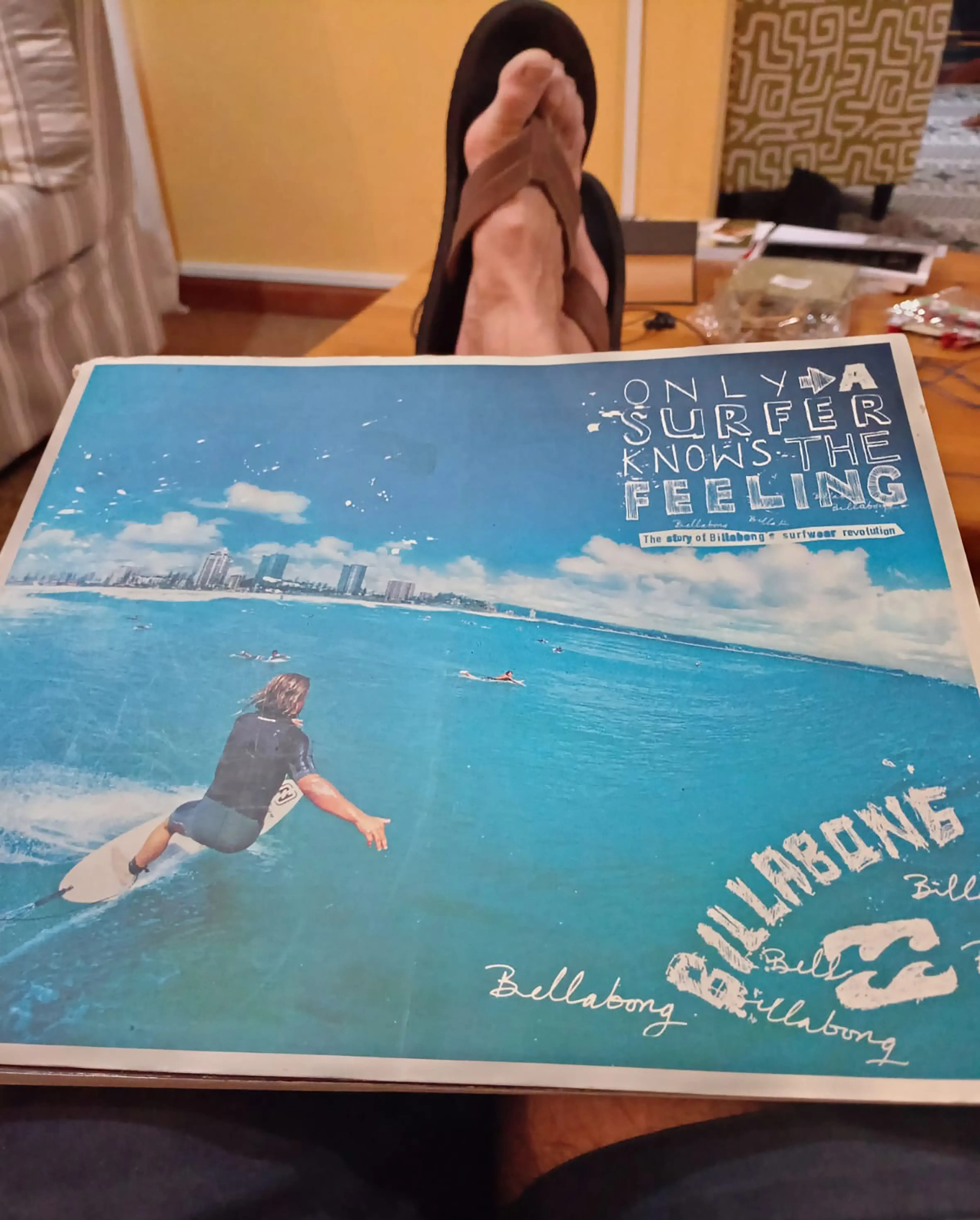

My friend Heiny Meiring has the most impressive surf magazine collection I have ever seen in all of my days.
He has entire years of Surfer and Surfing editions bound into annual volumes. Those were the days when the magazines came out once a month.
Now SA surfing magazine Zig Zag runs two prints a year, summer and winter, and they have just run a public advisory — no summer edition this year. Cancelled.
Print media is absolutely against the wall.
If Heiny has grandchildren that decide to become surfers, one wonders what they might say about grandad’s collection one day.
Hopefully, Raoul Duke is wrong on Instagram and TikTok is not turning us into a planet of idiots with no concentration span longer than 30 seconds.
Heiny lent me his History of Quicksilver. Now I am reading the Billabong story — only a surfer knows the feeling.
I am fortunate enough that when I started catching waves on my polystyrene bodyboard, I was riding in cut-off jeans. The excitement of board shorts was still to come.
Then it was surfing in the Selborne black-and-white stripe speedo.
I can’t remember if the sun made its way through the black stripes or through the white stripes but I can tell you that I was not the only scholar who had a permanent stripey bum when the speedo came off.
Wetsuits were in their infancy then, and most surfers did not have one.
And then one day, branded surfers’ baggies came along. That was cool.
Aussie legend Gordon Merchant is the father of Billabong, along with his ex-wife Rena.
The story of their surfwear revolution printed in 2003 in Singapore documents the brand's meteoric rise from cutting baggies on the kitchen table in 1973 and fiddling about with mom's sewing machine, to becoming a share listed company in 30 short years at 18 Aussie dollars per share in a company worth 3.84bn in 2013.
When the company fell off the stock exchange in 2013, they were down to 12 cents per share. How the mighty have fallen — all of this during this writer's surfing career.
Merchant, approaching 60 in 2003, tells some of the story in the foreword to the coffee table book and I am paraphrasing: “The amazing thing about the Billabong story is just how humble its beginnings were. Trying to cobble together a living that allowed maximum surf time.
“We never had any thoughts of the kind of company that employs over a 1,000 people worldwide and provides a livelihood for so many people, extending to photographers, film makers, suppliers and contractors (and professional surfers)."
When Merchant started with Billabong, about a dozen labels were making board shorts, but they were “lousy”, made with cotton thread that rotted in salt water. The fit was poor and they would creep up your waist while surfing.
“I remember one year at The Stubbies [Australian surfing contest], Mark Richards ripped his board shorts up the side. It was the only way you could get any leg movement in them.
“I’ll never forget the sight of MR up on stage accepting his trophy with these shorts ripped up the side,” writes Merchant.
This motivated the design and manufacture of the functional and durable Billabong boardies that we wear today.
Merchant closes his opening foreword: “Obviously the surf business has been very good to me, and I remain grateful for everything surfing has given me.
"In many ways I believe the act of surfing itself has helped fuel the amazing success of the surf industry.
“The ocean has an endless capacity to keep you honest, to keep things real.
"For me, going for a surf has always been the best means to get perspective on potentially daunting business issues.
“It's great to be able to empty your head. Get out there and stop thinking about business.
“It just seems to stir up the oxygen in your blood, and you seem to have much better thoughts anyway when you do go back to work.
“As our industry continues to grow, presenting once unimagined opportunities and challenges, now more than ever my key advice would be: keep surfing.”
Daily Dispatch