

Waterloo Farm, located just outside Makhanda, has been officially recognised by the International Union of Geological Sciences as one of the most critical geological heritage sites on Earth. The declaration, presented at a global conference in Monchique, Portugal, honours nearly four decades of groundbreaking palaeontological discoveries at the 365-million-year-old site.
SummaryOpen the quick read
- The International Union of Geological Sciences (IUGS) has named Waterloo Farm in Makhanda as a global Geological Heritage site.
- Rhodes University and Albany Museum researcher Dr Rob Gess accepted the accolade after studying the 365-million-year-old estuarine deposits for nearly 40 years.
- The site represents the world's only window into a high-latitude Late Devonian ecosystem, yielding early tetrapods, ancient lampreys, and the earliest known Gondwanan terrestrial animal.
- With 28 species described so far and dozens more awaiting formal classification, most fossils unearthed at the site are entirely new to science.
- Waterloo Farm joins iconic landmarks such as Mount Fuji and the San Andreas Fault in The Third 100 list of global geological heritage sites.
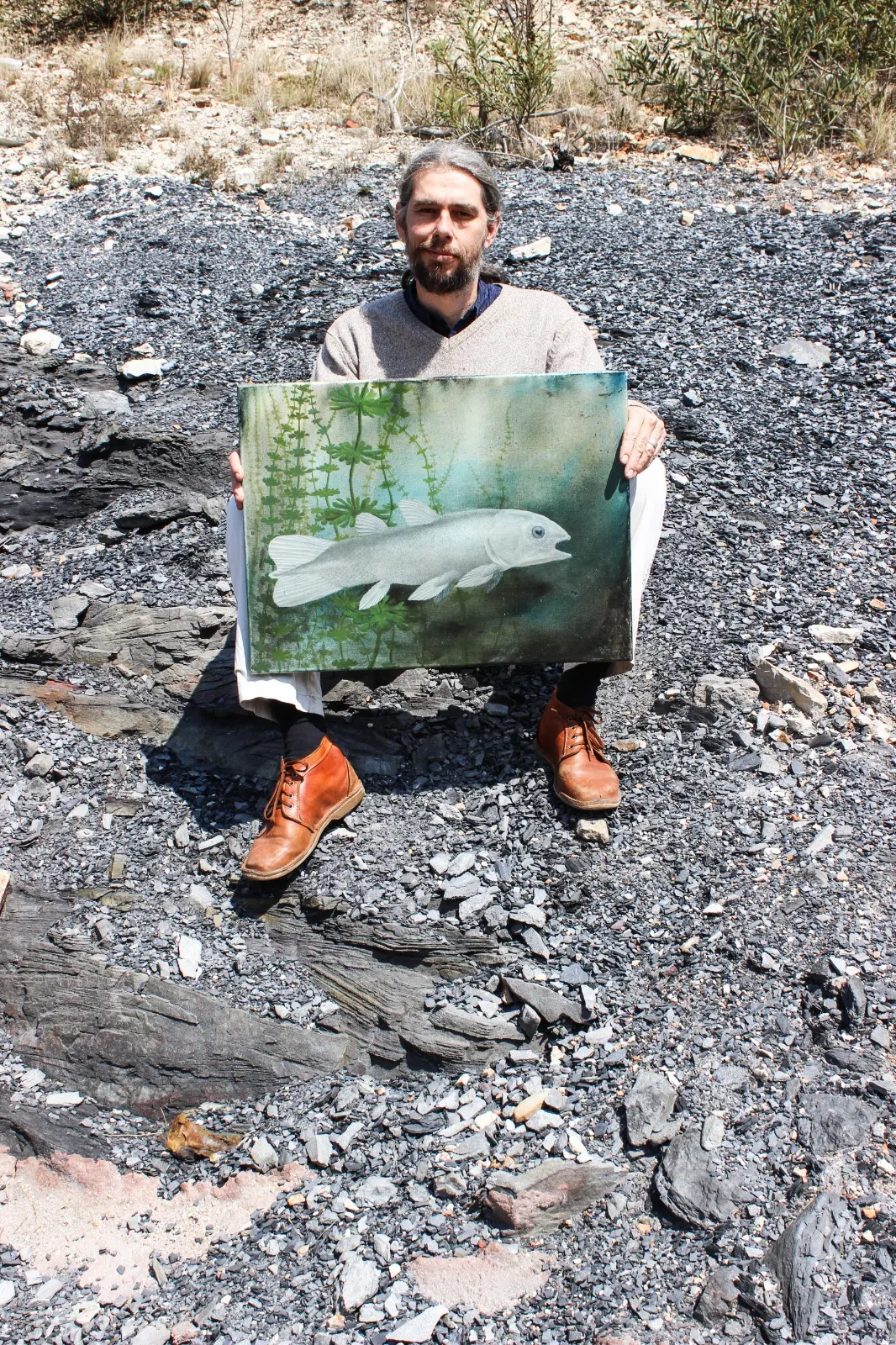

A collection of fossils dating back 365 million years, including some of the world's earliest four-legged vertebrates, has earned Waterloo Farm on the outskirts of Makhanda a place among the most important geological sites on Earth.
The International Union of Geological Sciences (IUGS) has recognised the site for its extraordinary fossil deposits, which provide a rare glimpse into an ancient world when the first vertebrates were making the transition from water to land.
The prestigious accolade was awarded at the IUGS's biennial conference in Monchique, Portugal, where Albany Museum and Rhodes University researcher Dr Rob Gess received a certificate acknowledging Waterloo Farm's inclusion in The Third 100, a selection of geological heritage sites from around the world.
For Gess, who has spent almost 40 years investigating the ancient deposits, the recognition marks another milestone in a lifetime of discoveries that have helped change scientific understanding of early life on Earth.
The Waterloo Farm fossils date to the Late Devonian period, when the land that would eventually become the Eastern Cape formed part of the ancient southern supercontinent of Gondwana, close to the South Pole.
At the time, the area was a coastal estuarine environment, home to an extraordinary diversity of fish, early four-legged vertebrates, plants and other organisms.
What makes Waterloo Farm particularly important is that it provides the world's only comprehensive record of a Late Devonian estuarine ecosystem from such a high-latitude, or circumpolar, setting.
Most other significant fossil deposits from this period represent environments much closer to the ancient equator.
Discoveries at Waterloo Farm have provided evidence of life in a part of the prehistoric world about which very little was previously known.
Among the most important finds are fossils of two early tetrapods, animals belonging to the evolutionary group that eventually gave rise to modern amphibians, reptiles, birds and mammals.
The two species, Tutusius umlambo and Umzantsia amazana, were described by Gess and Swedish palaeontologist Prof Per Ahlberg in the international scientific journal Science in 2018.
They were particularly significant because, until then, the known Devonian tetrapod fossils had come from tropical and subtropical regions.
Their discovery demonstrated that these early four-legged vertebrates were not restricted to warmer environments and may have been far more widely distributed than previously believed.
One of the species, Tutusius umlambo, was named in honour of Archbishop Emeritus Desmond Tutu.
Another extraordinary discovery was the world's oldest known fossil lamprey, Priscomyzon riniensis.
Lampreys are primitive, jawless fish whose ancestors provide important clues to the early evolution of vertebrates.
Specimens recovered from Waterloo Farm include individuals at different stages of development, from newly hatched young to adults.
These fossils have provided scientists with unusually detailed evidence of how ancient lampreys developed, adding to understanding of the evolutionary history of an animal group that survives today.
Waterloo Farm has also yielded the world's earliest known coelacanth nursery.
Coelacanths are an ancient group of lobe-finned fish, once believed to have become extinct millions of years ago until a living specimen was caught off the Eastern Cape coast in 1938.
The discovery of numerous juvenile coelacanth fossils at Waterloo Farm provided evidence that the ancient estuary served as a breeding and nursery habitat for these fish.
The fossil species, Serenichthys kowiensis, was described by Gess and University of Chicago researcher Prof Michael Coates.
Its name honours both Gess's mother, Serena, who helped provide space for storing fossil-bearing rock, and the Kowie River, which rises in the hills near the discovery site.
Other important finds include parts of a scorpion identified as the oldest known terrestrial animal from Gondwana.
The discovery provided evidence that scorpions had already colonised land on the southern supercontinent during the Late Devonian period.
The deposits have also yielded several species of armour-plated fish, primitive sharks, spiny-finned fish, early ray-finned fish and a variety of lobe-finned fish.
Seaweeds and a diverse range of plants have also been discovered, allowing researchers to reconstruct not only individual animals but much of the ecosystem in which they lived.
Because of the site's unique geographical position and exceptional preservation of fossils, almost every type of organism recovered has provided new scientific information.
So far, 28 species have been scientifically described and named, though Gess says this represents less than half of the plants and creatures known from fossils at Waterloo Farm.
The discoveries have been the result of decades of painstaking work, much of it involving the careful examination of shale recovered during road construction.
The fossil deposits were first exposed during roadworks in 1985, with Gess becoming involved in their investigation during the years that followed.
When further work was undertaken along the N2 in 1999, the South African National Roads Agency (Sanral) assisted Gess and his team in recovering about 30 tons of fossil-bearing shale before construction continued.
Another 70 tons were rescued during subsequent roadworks in 2008.
Rather than allowing the fossil material to be lost during construction, the shale was transported for storage and painstaking examination.
Many of the fossils have been uncovered through the careful splitting and preparation of rock, with some specimens requiring detailed work under a microscope.
The preservation of such large quantities of material has allowed research to continue long after the original excavations, with new discoveries emerging as further pieces are examined.
Gess's work has resulted in numerous scientific publications, often in collaboration with researchers from institutions elsewhere in South Africa and overseas.
His research has contributed to a growing understanding of the evolution of early vertebrates, the development of ancient coastal ecosystems and the distribution of life across Gondwana.
On the third day of the IUGS conference in Portugal, Gess presented the significance of Waterloo Farm to about 200 international delegates.
His presentation, entitled Late Devonian polar tetrapods and estuarine lagerstätte of Waterloo Farm, South Africa, outlined the importance of the discoveries made at the site.
A lagerstätte is a geological deposit containing exceptionally well-preserved fossils, sometimes including delicate structures that would normally be lost during fossilisation.
Waterloo Farm is particularly valuable because it preserves evidence of an entire ancient ecosystem rather than only a few isolated species.
Speaking from Portugal, Gess said the international recognition was an important acknowledgement of South Africa's geological heritage and its extraordinary fossil wealth.
South Africa is one of relatively few countries with important fossil deposits spanning so many different periods in the history of life on Earth.
He said the recognition would also contribute to the development of an Eastern Cape palaeo-heritage route, which is being planned as a contribution to the province's tourism economy.
The proposed route could help draw greater attention to the region's geological history and the scientific discoveries that have made it internationally important.
Waterloo Farm's inclusion in The Third 100 places it alongside some of the world's most recognisable geological landmarks, including Mount Fuji in Japan, the Norwegian fjords, the San Andreas Fault in the United States, Mount Aconcagua in Argentina and the Chocolate Hills in the Philippines.
The publication is the third volume of an envisaged four-volume collection, each identifying 100 sites of outstanding geological importance. The first 100 sites were announced in 2022.
The latest selection covers 47 countries, with 34 sites in Europe, 22 each in the Americas and Asia-Pacific region, 11 in Africa, six in the Middle East, three in the High Seas and two in Antarctica.
For Waterloo Farm, the recognition confirms its importance far beyond the Eastern Cape, and after almost four decades of investigation, with many fossils still awaiting scientific description, its contribution to understanding the history of life on Earth. — Talk of the Town