

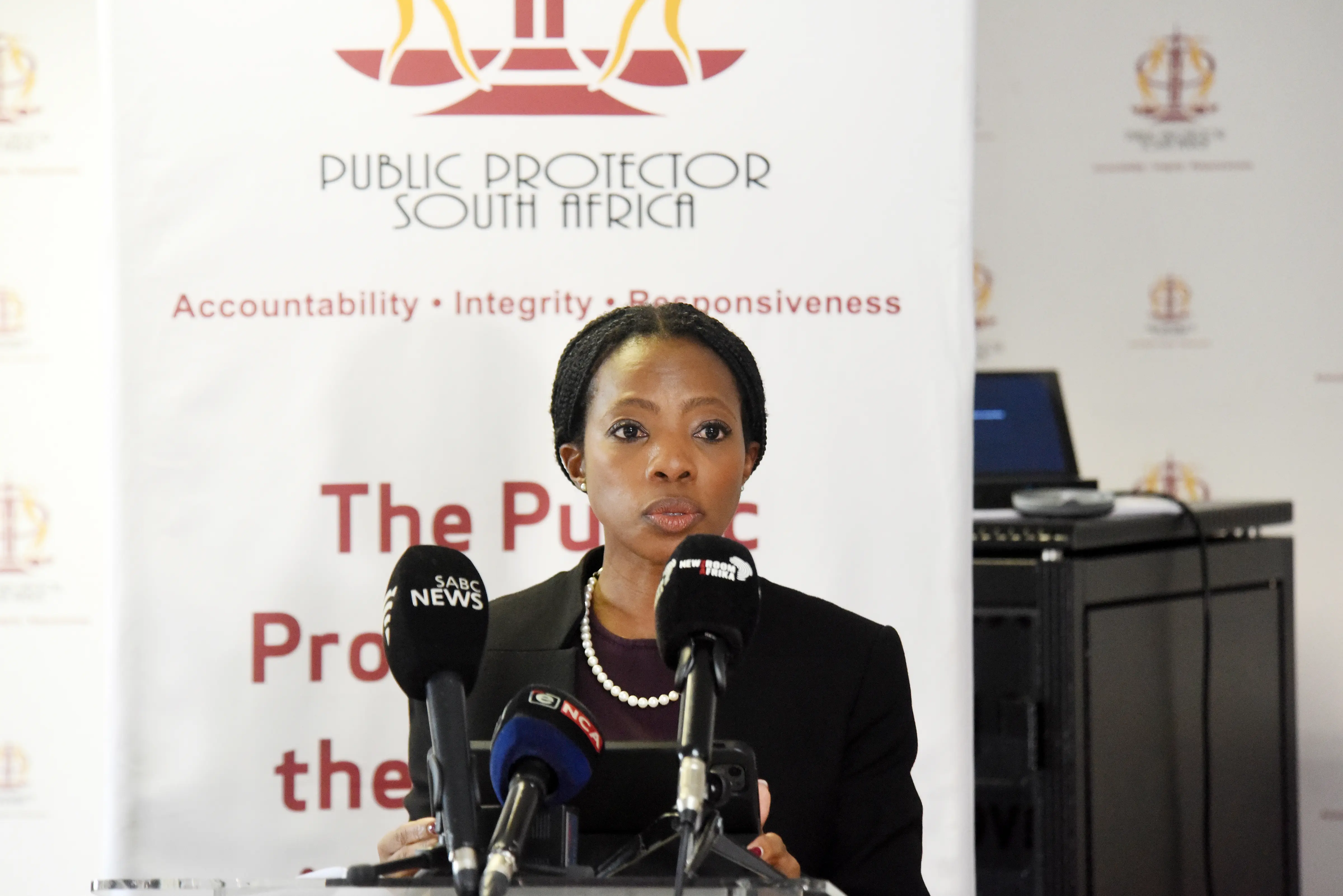
Public protector advocate Kholeka Gcaleka has declared that the public health sector in the Eastern Cape is in dire need of renewal.
This after a two-day visit to two health facilities in the province.
During her visit on Thursday and Friday, Gcaleka engaged with business and church leaders, before visiting hospitals in Gqeberha and Butterworth.
Speaking to the Dispatch during her Butterworth visit, Gcaleka said she had been pushed to visit hospitals in the province after numerous reports were sent to her office and provincial offices "of a stagnant health sector which has continually deteriorated since the Covid-19 pandemic".
Gcaleka started her programme with a meeting in Gqeberha with the business community,
According to her spokesperson, Oupa Segalwe, Gcaleka met business leaders in Gqeberha on Thursday.
The meeting came about "because of the important points of intersection between the institution's mandate and the interests of the private sector, which include public procurement, licensing, regulatory processes and the settlement of obligations arising from government contracts".
She then embarked on an unannounced visit to Livingstone Hospital in Gqeberha, which had already been under investigation by the public protector's office.
The investigation, which was done in 2021, had found that the hospital, a tertiary facility serving the Nelson Mandela Bay district and a wide referral area, was plagued by challenges including prolonged leadership vacancies, no approved organogram, underfunding and overcrowding, compounded by acute shortages of nurses, cleaners, porters and other staff.
Gcaleka said that the issue was not restricted to the one hospital, but rather that her office had been looking into the many public health facilities in the province.
"There are challenges with delivering basic health care, which are common challenges in the Eastern Cape," she said.
"I wanted to go and see [the hospitals] for myself.
"We need to ensure that we are able to monitor the implementation of these remedial actions throughout the country.
"It is a challenge, very little progress has been seen since the time of Covid-19."
Gcaleka said hospitals in the province were not sticking to the constitutional mandate of treating people with dignity, referencing a visit at Livingstone Hospital and reports made about the Butterworth Hospital.
"I must say we are completely dissatisfied with the state of affairs at Livingstone Hospital," she said.
"We must acknowledge that there are a few things that have been addressed, which we had raised in our report, which was into the state of the healthcare system in SA.
"However, the crux of the issues, doctors, nurses, having sufficient staff to be able to deliver the services and meet the demand, those issues have not yet been addressed.
"Yes, beds have been delivered, but they are not sufficient.
"The demand is higher, but the reason why the demand is higher on Livingstone as a tertiary hospital, is that the issue of primary and secondary services within the healthcare system have not been addressed.
"Now, those were all the issues which we had mentioned in our report, because at the end of the day, the constitution calls upon the right to life for people to be treated with dignity, and the healthcare centre is one of those machineries of the state which ensure that what is enshrined in our constitution is realised by our communities."
Her comments follow the South African Human Rights Commission's (SAHRC) visit to Ntabozuko in July, where a clinic servicing the area was under preliminary investigation on whether it had been denying patients their right to dignity and privacy.
After the visit, the Dispatch was told that the situation at the clinic was concerning and that the department had a few questions it had to answer.
Meanwhile, in August, the health department was called a dead zone after a week-long oversight visit to the various health facilities in the province by the provincial legislature's health portfolio committee.
Committee chair Koliswa Vimbayo said at the time said that of the facilities visited, some raised troubling concerns, pointing out the state of the Holy Cross Hospital in Flagstaff.
"The delegation found significant infrastructure and service delivery challenges still unresolved," she said.
"The hospital, which serves more than 600,000 people, is also facing critical staff shortages, while 44 hospital beds remain unusable.
"Additional concerns included the lack of a dedicated mental health unit, the closure of the rehabilitation unit and delays in key infrastructure projects," Vimbayo said.
Speaking on how the sector could be renewed and brought back to life, DA MPL Jane Cowley said that a review of the financial management of the department's books was needed, alongside an overhaul of the department's management.
"The department has long talked about a plan to re-engineer healthcare services in the province, by strengthening primary and secondary healthcare services, but this 'plan' remains largely unfunded and unimplemented," Cowley said.
"The main reason for this is that the department is factually bankrupt and carries billions of rand of unsettled debt.
"It therefore purposefully does not fill critical clinical and non- clinical funded posts and instead use that money to try to partially settle debts and successful medico-legal claims against it.
"Although the term consequence management is bandied about at every meeting, this is a rare occurrence.
"Consequences for unethical behaviour and malfeasance of any sort should be dealt with swiftly and harshly if we are to change this culture of abuse," Cowley said.