


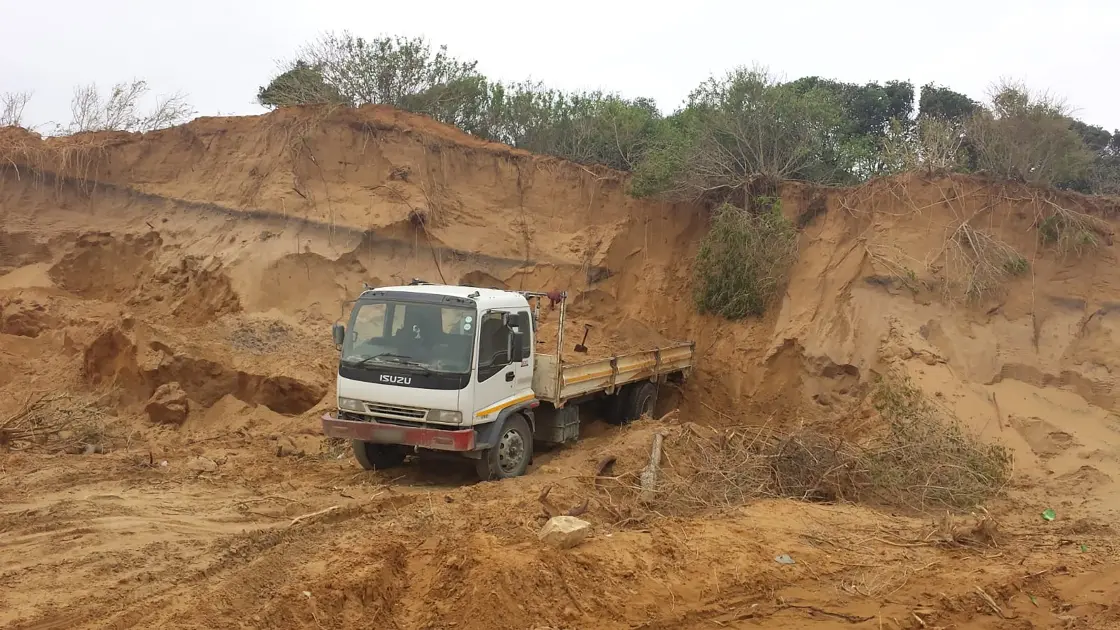
Sand truck owners in the former Transkei have accused the police of harassment and officials of imposing crippling fines when they are caught collecting sand from rivers, saying the government should help them comply with the law rather than threaten their livelihoods.
Nearly 100 truck owners gathered at the All Saints Hall in Mthatha on Thursday to discuss what they described as intimidation by police and mineral resources officials.
They claimed trucks had been impounded in areas including KwaBhaca, Ngcobo, Qumbu, Mthatha, Tsolo, Libode and Ngqeleni, with owners facing fines of up to R100,000.
They said drivers were also being fined R20,000 and their assistants R5,000.
“Collecting the sand and selling it is a traditional way of life in the rural areas," former Qumbu Truck Owners' Association secretary Zenande Mngcele said.
"When people moved from mud houses and started building with bricks and cement, some people took the opportunity to collect [sand] and sell it to the people so that they can also be able to feed their families.”
Mngcele said the government should explain the legal requirements and help operators obtain the necessary permits instead of impounding their vehicles.
“Our government is too harsh towards us because we are arrested but we have never been engaged on anything.
"We do not know if there is an old law that says we cannot collect and sell the sand because there was no awareness done by government so that we can know whether what we are doing goes against the law.”
He questioned why operators using excavators to remove sand from rivers appeared to escape enforcement.
KSD Truck Owners' Association spokesperson Masibulele Njemla said many impounded trucks remained at police storage facilities because their owners could not afford the fines.
Njemla, a former taxi driver who entered the sand business three years ago, said operators had believed that traditional authorities controlled access to resources on communal land.
“We were always under the impression that land in rural communities was under kings and iinkosi [chiefs] and not government.”
He said more than 70 truck owners operated in and around Mthatha, each employing three young men, to load sand.
“Now if we are being arrested and heavily punished, what happens to those young men?”
African Transformation Movement national organiser Nkoliso Flatela, who attended the meeting, accused officials of misinterpreting the National Environmental Management Act.
He claimed the legislation provided for notices to be issued to illegal sand miners and prescribed a maximum fine of R10,000.
“Government must explain what the difference is between mining and collecting sand because these people are just scooping sand from the top and not digging and sand mining,” he said.
The department of mineral resources could not be reached for comment on Thursday.
Eastern Cape economic development, environmental affairs and tourism spokesperson Ncedo Lisani said sand extraction, including the collection of sand from riverbanks, might constitute mining activity regardless of whether it was done manually with a shovel or mechanically with machinery.
The legality of the activity depended on compliance with the applicable legal requirements and authorisations.
"The mandate for regulating mining, including illegal sand mining, rests with the department of mineral and petroleum resources," Lisani said.
"[Economic development, environmental affairs and tourism] does not issue mining permits or determine whether an activity constitutes illegal mining.
"However, when sand extraction or mining results in environmental degradation, such as damage to riverbanks, watercourses, wetlands or vegetation, [the department] becomes involved under its environmental management mandate.
"The department works with the [mineral resources department] and other relevant law-enforcement authorities, including the SAPS, where necessary.
"Each case must therefore be assessed according to its specific circumstances, including the nature, location and scale of the activity, the applicable authorisations and the environmental impacts.
"Penalties are determined in accordance with the applicable legislation and by the competent authority.
"Where warranted, offenders may also be referred to the National Prosecuting Authority for prosecution."