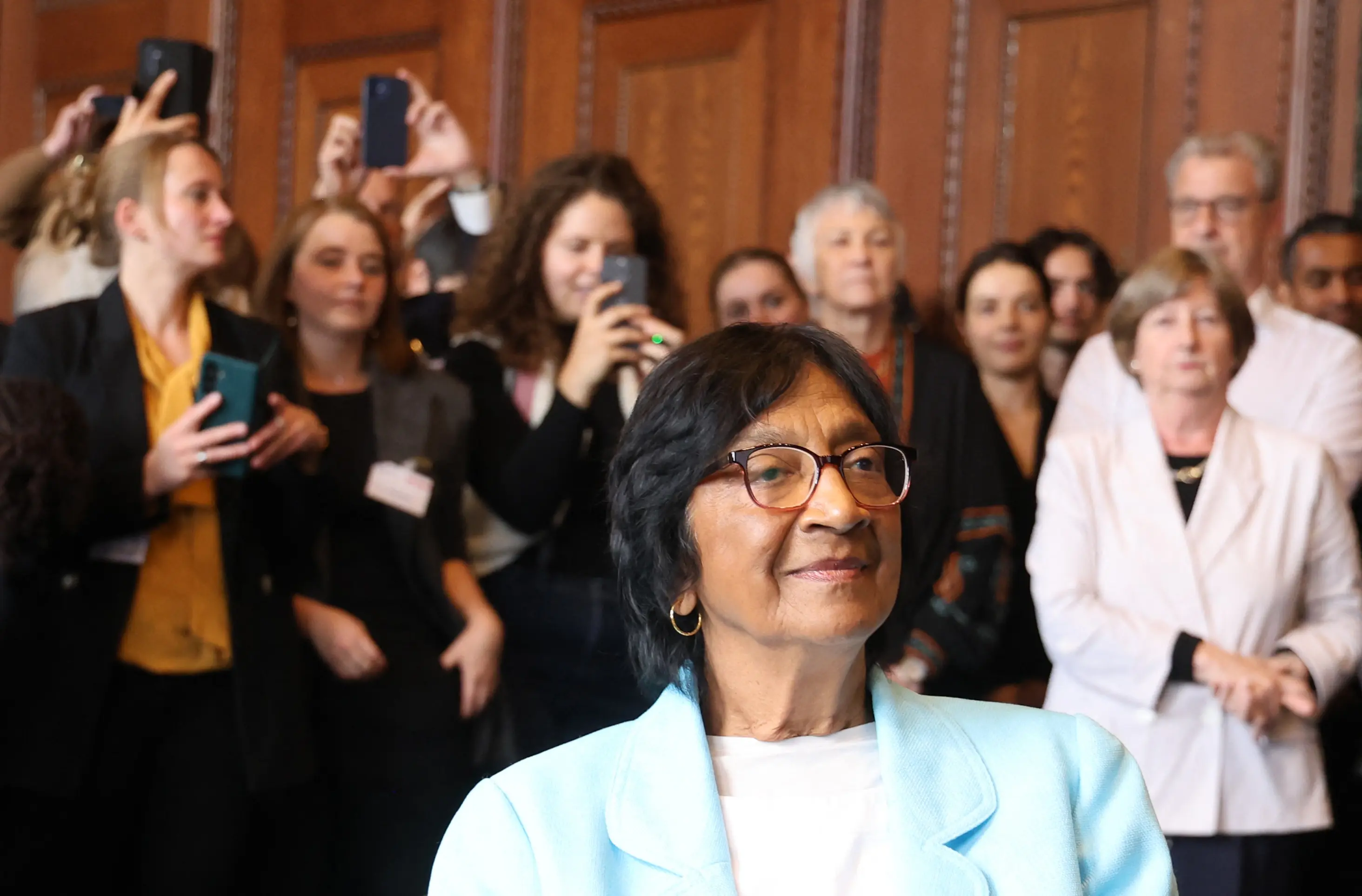
South African judge and human rights champion Navi Pillay has won the 2026 Nobel Peace Prize for her lifelong fight against war crimes, crimes against humanity and genocide, drawing praise from world leaders and a furious response from Israel.
Pillay, 85, who headed the Rwanda genocide tribunal and presided over a UN commission which accused Israel of genocide in Gaza, is the fifth South African to receive the prestigious award.
Speaking on Friday in the historic courtroom in Nuremberg, Germany, where Nazi leaders were prosecuted after World War 2, Pillay dedicated the honour to victims of atrocities.
"Let me dedicate this award to all of the survivors of international crimes," she told a press conference.
President Cyril Ramaphosa welcomed the announcement, describing it as a "profound tribute to the veteran jurist's courage, integrity and lifelong commitment to justice".
He said the award "allows us to celebrate the progressive contributions she has made to strengthen peace, uphold human dignity and bring hope in South Africa and to peoples globally".
"She has served humanity with principle and the belief that the world can and should be a better place," Ramaphosa said.
The Norwegian Nobel Committee announced the award in Oslo on Friday, recognising Pillay's decades of work in international justice.
Committee chair Jorgen Watne Frydnes said she had been "instrumental in ensuring that war crimes, crimes against humanity, and genocide are prosecuted".
"In historic international court cases, she has shown that legal measures can help prevent acts of war and violence," the committee said.
Pillay's "independence, her expertise and steadfastness have made her one of the most respected international jurists of our time."
Born into a South African family of Tamil descent, the daughter of a bus driver began her legal career defending anti-apartheid activists.
She became South Africa's first non-white woman High Court judge and, in 1973, secured the right of political prisoners on Robben Island, where Nelson Mandela was imprisoned, to have access to lawyers.
Her career subsequently took her to the International Criminal Tribunal for Rwanda and the International Criminal Court.
She also served as UN High Commissioner for Human Rights from 2008 to 2014.
More recently, Pillay headed the UN Independent International Commission of Inquiry, which last year concluded that genocide was occurring in Gaza.
The commission, which does not speak on behalf of the UN itself, shared "thousands of pieces of information" with prosecutors at the International Criminal Court, Pillay told AFP at the time.
Israel rejected the commission's findings as "distorted and false".
On Friday, its foreign ministry strongly condemned the Nobel decision.
"It's the grotesque weaponisation of an award to legitimise anti-Israel hatred and prejudice," the ministry wrote on X.
"Now that the Nobel commission has rewarded the biggest lie of the 21st century, Joseph Goebbels is certainly applauding from hell," it added, referring to the Nazi propagandist.
The Nobel committee stressed that the award recognised Pillay's broader career and did not constitute a finding on whether Israel had committed genocide in Gaza.
"We are not the court," Frydnes told AFP.
"It's her report, the Commission's report... It will be decided by the International Court of Justice," he said.
Pillay, who is currently serving as a judge at the International Court of Justice in a case involving allegations of genocide against Myanmar, appeared surprised by the controversy surrounding her work.
Speaking after receiving a standing ovation in Nuremberg, she reflected on the praise she had received for her role in the Gaza inquiry.
"You can imagine how surprised I was. Why would you need courage to speak the truth?"
The award also prompted a light-hearted reference to US President Donald Trump, who has repeatedly expressed his desire to win the Nobel Peace Prize.
"If you clap a little bit more I may share this prize with Trump," Pillay joked during the standing ovation, captured in a video posted on X by Amnesty International secretary-general Agnes Callamard.
Trump has claimed to have ended as many as eight wars and has repeatedly argued that he deserves the prize.
His administration has also imposed sanctions on international justice officials and challenged the authority of international institutions.
Frydnes said Friday's decision sent a message to governments seeking to undermine international justice.
"This is a clear message to those who are putting pressure on these institutions, to those who are sanctioning the judges and are attacking the institutions. That needs to stop," he told AFP.
The Nobel committee said international law had become increasingly important amid growing global conflict.
"At a time of existential challenges -- including more wars and conflicts than the world has seen in a long time -- international law is no longer just a supplement to peace and security."
"It is an absolute necessity."
European Commission president Ursula von der Leyen congratulated Pillay for confronting "some of humanity's darkest chapters".
"She has looked the brutality of injustice in the eye and never looked away. She is the defender of the persecuted, the vulnerable, the voiceless and the excluded," von der Leyen wrote on X.
UN High Commissioner for Human Rights Volker Turk described the award as "a recognition, a reaffirmation that human rights, the rule of law and justice, and accountability are fundamental to everything, to peace, to security, and prosperity".
International Criminal Court president Tomoko Akane also welcomed the announcement.
"At a time of profound challenges to the international legal order and the rule of law, this recognition carries particular significance," Akane said.
Pillay joins four previous South African Nobel Peace Prize laureates: ANC leader Albert Luthuli, who received the award in 1960; Archbishop Desmond Tutu in 1984; and Mandela and former president FW de Klerk, who shared the prize in 1993.
Ramaphosa said the latest honour highlighted "the far-reaching impact of South Africans on peace, justice and the advancement of humanity".
Pillay will receive a gold medal, a diploma and prize money of about $1.2m at a ceremony in Oslo on December 10, the anniversary of the death of prize founder Alfred Nobel in 1896. — AFP