

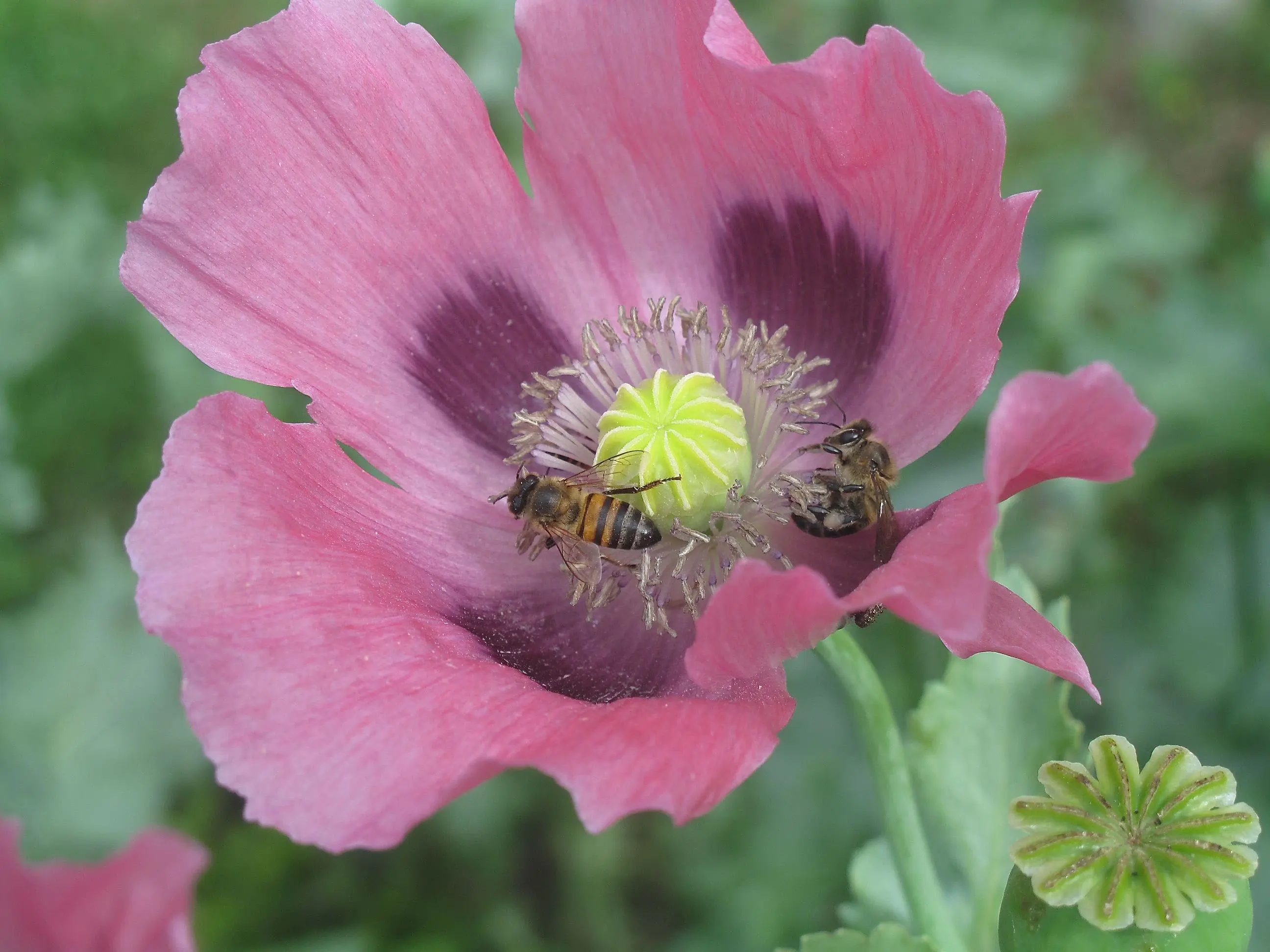

The garden is abuzz at present with happy sounds of bees about their business collecting pollen from the poppy flowers (Papaver Orientale) in shades of red, purple, lilac and pink.
Pollination is in progress. While the bees are busy with gathering the food the pollen offers, some of it rubs off and sticks to the female part of the next flower they visit, allowing this plant to fertilise and grow seeds.
Poppies have grown en masse in our front garden, thanks to the scattering of the seeds from their pods which have readily dispersed the seeds of the previous season.
These many gorgeous poppies in bloom in the garden also remind us of our Christmas visit to Tasmania when we were living in Australia.
We’d stopped on the roadside to admire the view when we came upon fields of mauve opium poppies (Papaver somniferum).
Opium poppies have been grown in Tasmania commercially for 60 years.
They are used for the extraction of "the valuable alkaloid material" they contain, including morphine, thebaine and codeine, for use in the pharmaceutical industry.
They also form the base ingredients for weight loss medicines.
Thebaine is used to reverse opioid overdose or treat opioid addiction.
Apart from the lovely sight of a field of flowers in bloom, the Tasmanian memory was probably imprinted too, as a result of a naive reaction to seeing opium fields, of a known narcotic drug, that looked so lovely.
I’ve often wondered if our country’s farmers could grow the opium poppy here for commercial gain.
The opium poppy looks much the same as an Oriental poppy in its appeal.
The Oriental poppy growing in my garden is native to the semi-arid regions of Caucasus, north eastern Turkey and northern Iran.
It is grown for its vibrant coloured showy flowers which can reach up to 15cm across.
Ideal for adding height to a planting, it can grow up to 60 to 120cm tall.
And as this season proceeds, it allows you to marvel at its example of nature’s perfect design.
It’s often said to be a "masterclass in evolutionary adaptation" specifically designed to optimise reproduction (pollination and seed dispersal) and survival in harsh environments of where it originated.
For example, the bullseye contrast with black or purple centre formed by the clustered stamens, which stands out against its vibrantly coloured petals, creates a highly visible "target" for its pollinators.
Rather than offering sugary nectar, it instead produces a huge amount of nutrient-rich pollen which bees, especially, rely on for their early summer food source.
Its large paper crepe-like petals form a bowl shape which traps the warmth of the sun, warming visiting insects, increasing their energy and inviting them to stay a while.
Butterflies and hummingbirds are also attracted to the flowers.
When injured, the plant secretes a bitter latex-like sap which contains alkaloids preventing insects and other pests from consuming the foliage.
This could be why buck and rabbits tend to avoid Oriental poppies.
After blooming in early summer, the plant dies back to the ground.
After the recent winds in our area, most of the petals have blown off.

The central ovary has become swollen in the shape of a hard decorative capsule.
This round seed pod is about the size of a big marble or larger.
At the top of the pod sits a flat disc which looks like a spoked wheel.
When it is immature, the seed pod is green.
As it dries, it hardens and turns a papery light brown colour in form and is ready for seed dispersal.
Inside this pod are thousands of tiny black seeds.
When the pod dries out, tiny pores open up beneath the disc.
As the wind blows, the pod acts like a salt shaker, scattering seeds in all directions to ensure the growth of the next generation of poppies.
If you remove the dried seed pods at this stage, you can break them open and shake out the seeds to store for planting in autumn next year.
There are so many they may be shared with gardener friends or swapped for different coloured poppy flowers.
It is best to store the seeds in a paper bag. Remember to label it clearly.
Or keep the seed pods whole to use in a dried flower arrangement, a Christmas or special event wreath.
At the Bedford Open Garden’s Show last year, they were selling small envelopes of these poppy seeds which was helpful as it was great to be able to have seeds producing flowers of a colour I did not have.
The seeds may be planted in late autumn or winter in wait for them to bloom in spring into summer.
Poppies are relatively easy to grow, enjoying a sunny to light shade location in well-draining soil.
Their foliage is a grey-green which is fairly curly with interesting bumps and points, providing an attractive contrast to companion plants with smooth green leaves.
Poppies make attractive cut flowers. I don’t know if this is an old wives’ tale but I was once told that the flowers bloom longer if you burn the end of their stems.
An easy way to do this is to cut the stem to the required length and use the flame from your gas stove plate to carefully burn just the ends.
I do this with dahlia stems for the vase too.