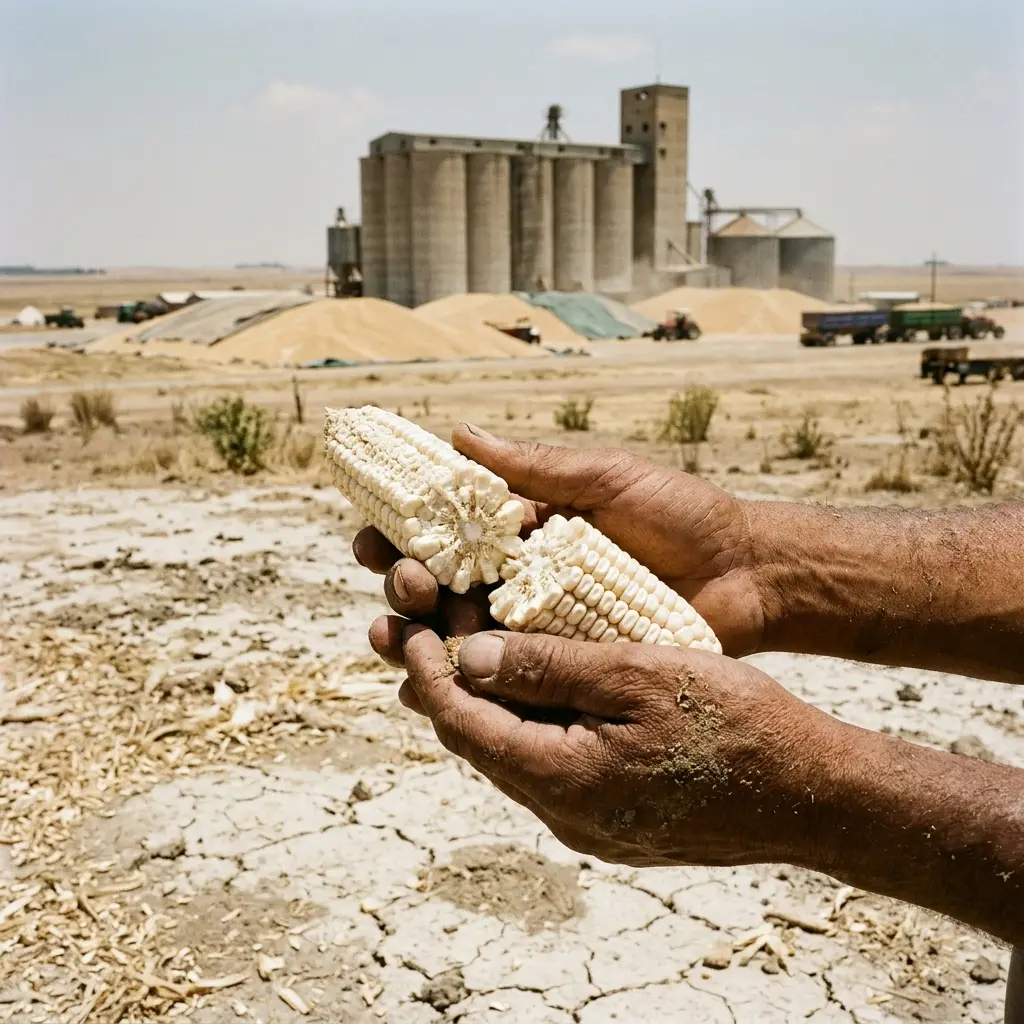
Biological inflation is the steady drop in the nutrient value of every rand spent on food.
Biochemist Donald Davis and his colleagues tracked United States food composition records across 43 garden vegetable crops over fifty years and found consistent declines in protein, calcium, iron, vitamin C and riboflavin (which fell by 38%).
In the United Kingdom, historical records showed copper in everyday vegetables fell by around three quarters.
SA has never published an equivalent historical audit of its own Medical Research Council food composition tables. We track food prices to the decimal point while flying blind on food quality.
The maths is unforgiving. Suppose a bunch of spinach rises in price from R20 to R25 (+25%). If that same spinach carries 20% less iron than it used to, the real cost per milligram of iron has not risen by 25%. It has risen by more than 55%.
This is a silent double tax on the poor. Low-income families rely on a narrow basket of staples, where a small side-portion of vegetables carries almost the entire micronutrient load of the meal.
(Which is why at FTFA we focus so heavily on home, school and community vegetable and herb production, where one of our core metrics of success is the increase in crop diversity.)
Four distinct mechanisms drive biological inflation between the seed and the plate:
1. Genetic dilution: Decades of breeding crops solely for fast growth and weight swell plant cells with water and starch faster than roots can pull in minerals.
2. Soil dilution: Plants rely on a living underground network of organic carbon, bacteria and fungi to unlock minerals from soil particles.
Yet studies across the SA Highveld show that continuous monoculture ploughing has wiped out up to 65% of soil organic carbon and 60% of microbial life.
In the Eastern Cape, soil surveys found 79% to 100% of smallholder plots are critically short of phosphorus.
Meanwhile, commercial NPK-only farming (feeding crops just nitrogen, phosphorus and potassium while human bodies need twenty minerals) acidifies soil, suppresses mineral-trading fungi and leaves grain short of trace elements like sulphur.
As recent African research in Nature proved, your soil is your supplement.
3. Processing dilution: Most SA households prefer super-refined white maize meal. Industrial dehulling strips the germ and bran, removing roughly 62% of the zinc and 48% of the iron before the meal leaves the mill.
4. Atmospheric dilution: Field trials in Nature show that rising carbon dioxide causes C3 crops (including almost all vegetables, leafy greens, herbs, beans, peas and wheat) to pack on extra starch while losing 5% to 15% of their zinc, iron and protein.
Why has our food system let all four diluters run unchecked? Because agricultural markets are stuck in the tonnage trap. Farmers are paid for crate weight and appearance, never nutrition.
Under SA regulations, white maize is graded only on physical defects, foreign matter and moisture. A farmer growing mineral-dense maize in living soil gets the exact same price per tonne as a grower delivering hollow starch.
Yet when a farmer delivers bread wheat in SA, the grading table includes minimum protein levels. Wheat farmers get paid more for higher protein. The tonnage trap is a policy choice, not a law of nature.
Right now, South Africans are paying twice for this broken pipeline. First, our farming and milling systems strip nutrients out of our soils, vegetables and grains upstream.
Then, under 2003 fortification rules, we pay to add synthetic vitamins and minerals back into refined flour at the factory, while public hospitals carry the massive downstream cost of stunting, anaemia and diabetes.
Fixing this requires upstream fortification through integrated agroecology. In a sixty-year KwaZulu-Natal sugarcane trial, simply keeping crop residues as mulch rebuilt soil carbon and potassium.
In nine-season Zambian trials, intercropping maize with legumes produced 25% more energy and nearly doubled protein yield per hectare.
In FTFA’s permaculture gardens, deep organic trench beds, mulching and companion herbs reactivate soil biology and pack bioavailable iron, trace minerals and antioxidants into daily meals.
To scale this across the country, we need to replace tonnes per hectare with Nutritional Yield per Hectare (counting how many people’s daily nutrient needs a hectare can meet).
First, our Crop Estimates Committee should report nutritional yield alongside harvest tonnage, while Statistics South Africa pilots a Nutrient-Adjusted Food Price Index tracking rand per milligram of iron and zinc.
Second, big buyers like the National School Nutrition Programme (which feeds over nine million learners daily) and Land Bank blended finance should tie contracts and funding to soil health and crop mineral density.
Finally, FTFA is inviting universities, laboratories and corporate ESG partners to join us in open-access research comparing the mineral density of regeneratively grown garden produce against standard supermarket produce.
SA has spent a century perfecting how to count its harvest in tonnes. Now we need to count it in milligrams.
Christopher Wild is Executive Director at Food & Trees for Africa